
Spades
Play Spades the American way, partnered with Dottie across the table against Earl and Frank, three computer players who bid and play by the book. Bid your tricks, cover a nil, set the other side, and keep an eye on the bags.
How this table works
Before the first deal you see the rules and three options. A match ends at 500 points, the standard (or 300 for a shorter one). The bag penalty is on and blind nil is off, as most players expect, and you can change either. You set the level of your opponents and, separately, of your partner: Easy, Standard, or Expert.
When it's your turn to bid, a row of buttons appears on the cloth, Nil and 1 through 13. You can also type the number (1 then 0 for 10) or press N for nil. To play, tap a card. Table settings hold Tap twice to play, card size, four-color suits, sort order, and speed (Stately, Brisk, or Off).
The scoreboard shows each side's bid, tricks, score, and bags, and whether spades have been broken. Undo (key U) takes you back to your last decision in the hand; Hint (key H) marks the card or bid an Expert player would choose. After each hand the summary itemizes both sides' scores, and Show all hands lays out the four hands as dealt.
The Menu holds Replay this deal, Today's deal, statistics, and Copy deal details. The Classic button swaps the portraits for plain faces. To let the Company play a hand by itself, watch a hand. The table is silent until you press the speaker button on the toolbar; then it plays quiet card sounds, with a fanfare for a nil made, and one more press mutes everything at once.
The Intermission button
Your cover when a colleague comes by. One press of the Intermission button, or of ` (the panic key, left of 1, unless you pick another), and the game gives way to a plain curtain or to office work. It goes full screen where the browser can, and the tab gets a dull name; two presses of Escape hide the window only. The panic key, Escape twice, or the little corner control brings back your hand untouched. In the Menu, Table settings pick the screen (Report, Inbox, Spreadsheet, Code editor, Dashboard, Curtain, or Project plan), switch Go full screen, and set the Panic key: `, \ or F2. All about it.
How to play
Four players in two partnerships, partners sitting across: you and Dottie against Earl, on your left, and Frank, on your right. A standard deck, no jokers, aces high. Spades are always trump. Each player gets 13 cards, and deal and play go clockwise. The first dealer is drawn at random and the deal passes to the left after every hand.
The bidding
There is one round of bidding. Starting with the player on the dealer's left and ending with the dealer, each player names the number of tricks they expect to take, from 0 to 13. Nobody passes, no bid has to top the last one, and no bid can be changed. Partners' bids are added together to make the side's contract: if you bid 4 and Dottie bids 3, your side needs 7 tricks between you, and it doesn't matter which of you takes them.
Nil
A bid of zero is nil: a promise to take no tricks at all. It's scored on its own, 100 points for the side if the bidder takes nothing and 100 off if the bidder takes even one trick. The partner's bid stands as the side's whole contract and must still be made by the partner alone. Tricks taken by a nil bidder who fails never help the partner's contract. If both partners bid nil, the side has no contract, and each nil is scored separately.
Blind nil
With the Blind nil option on, a side that is at least 100 points behind at the start of a hand may bid nil without looking at the cards. Your hand stays face down until you decide: when your turn comes, choose Bid blind nil or Look at my cards; once you look, the chance is gone for that hand. A blind nil is worth 200 either way. After the bidding, the blind nil bidder passes 2 cards face down to the partner, who then passes back any 2, possibly the same ones. Some groups make this exchange optional; at this table it always happens. Only one partner on a side may bid blind nil in a hand.
The play
The player on the dealer's left leads to the first trick: any card but a spade, unless the hand holds nothing else. Everyone must follow suit if able. A player who can't follow may play any card, a spade or a discard; nobody is ever required to trump or to beat the card that is winning. A trick containing a spade goes to the highest spade; otherwise the highest card of the suit led wins it. The winner leads next.
Leading spades
Spades may not be led until they have been broken, meaning a spade has been played to a trick on another suit's lead, or until the leader holds nothing but spades.
After the last trick
The two sides' tricks always total 13; each side's tricks are checked against its contract and nils, and the bags are updated.
Winning the match
The first side to reach 500 (or 300, if you chose the short match) wins. If both sides reach it on the same hand, the higher score wins; if they finish exactly level, another hand is dealt. A side whose score falls to −200 or below loses the match on the spot, at either target.
Scoring
| Result | Points |
|---|---|
| Contract made | 10 per trick bid |
| Each trick over the contract (a bag) | 1, and one bag counted |
| Contract set (fewer tricks than bid) | minus 10 per trick bid, no bags |
| Nil made or broken | 100 or minus 100 |
| Blind nil made or broken (option) | 200 or minus 200 |
| Each trick taken by a broken nil | 1, and one bag counted |
| Every 10 bags | minus 100, and 10 come off the count |
Bags carry from hand to hand for the whole match. The penalty is taken before anyone checks for a winner, so a side can reach the target with its tricks and fall back under it with its bags. With the bag penalty off, overtricks still score 1 each and no count is kept.
A worked hand. Match to 500, default options. Before the hand: your side 312 points with 8 bags, the opponents 268 with 4 bags. You bid 4 and Dottie bids nil; Earl bids 3 and Frank 3. You take 6 tricks, Dottie none, Earl 4, and Frank 3.
- Check the tricks: 6 + 0 + 4 + 3 = 13.
- Your side's contract is 4, your bid alone, since Dottie bid nil. You took 6: 4 × 10 = 40, plus 2 overtricks × 1 = 2. That makes 42 points and 2 bags.
- Dottie took no tricks, so her nil is made: 100 more, 142 for the hand so far.
- Bags: 8 + 2 = 10, which reaches the limit of 10. Minus 100, and the count goes back to 0. Your side adds 142 − 100 = 42.
- The opponents' contract is 3 + 3 = 6. They took 7: 6 × 10 = 60, plus 1 overtrick = 61 points and 1 bag. Their count goes from 4 to 5.
- New scores: your side 312 + 42 = 354 with 0 bags; the opponents 268 + 61 = 329 with 5 bags. Neither side is at 500, so the next hand is dealt.
Had Dottie been forced to win one trick, leaving you 5: contract made with 1 bag (41), nil broken (−100), her trick a point and a bag (1). That is −58, and the 2 new bags still reach 10, for another 100 off: −158 for the hand.
Playing it well
Bidding
Count the tricks that can't be taken away first, then the likely ones. In spades, the ace is a trick and the king is one if it has at least one spade beside it; the queen is worth a little more than half a trick with two others to guard her. Each spade beyond the third is close to a full trick late in the hand. ♠A K 4 2 is two tricks and a maybe; ♠Q 10 8 6 4 is about two, almost all from length.
In the side suits, an ace is a trick. A king is worth most of one in a suit of three or more cards, half with one card beside it, and almost nothing bare. A queen counts only with three or more cards and the ace or king in the same suit. Shortness pays only if you have spades to trump with: with three or more spades a void is about a trick and a singleton about half, and with two or fewer spades it's worth nothing.
Add it up and round down. A count of 3.6 is a bid of 3, not 4. A set costs 10 a trick bid; an unbid trick that comes in costs you only a bag.
Nil, yours and theirs
Bid nil with low cards and no unguarded high ones. ♠7 3, ♥9 6 4 2, ♦10 8 5 3 2, ♣8 4 is a good nil: two small spades, long suits to keep ducking under, nothing above a 10. The trap is a lone high card in a short suit, above all a high spade with no low spades to hide behind. Don't bid nil when your partner already has. When your partner bids nil, bid one more than you would otherwise: covering means winning tricks you'd normally let go.
To cover your partner's nil, lead high cards so the low ones can slip underneath, and play the top card in a suit where the nil hand is short. A 2 dropped under your ace usually means your partner is out of that suit. To attack an opponent's nil, lead the suits where the nil hand is likely to hold a middling card and play low from your middle cards, so that card ends up winning. Late in the hand, when the nil bidder may be the only other player with spades left, lead a low one: if every spade in that hand is higher than yours, the nil is broken.
Play
Don't overtake your partner's winning card unless the player after you would otherwise win the trick, or a nil needs stopping.
Read the total of the four bids. At 13 there is no trick to spare, and above it one side is certain to be set: draw trump early if you have the length, because the spades decide who gets the last side-suit tricks. At 9 or fewer, bags are coming; push the extras to the other side.
With four or more spades and aces and kings outside, lead spades and pull the opponents' trump before they can trump your winners. Once your contract is safe and your bag count is high, duck every trick you can, and keep high cards only for tricks nobody can take from you. When a suit's top card has fallen, throw your 8, 9, or 10 of that suit and keep the low ones for ducking later.
Near the end, bid to the target and no further. A side at 440 in a match to 500 needs 60: bid 6, make it, and stop taking tricks. A side at 490 with 8 bags should not take one trick more than it needs.
The Company in Spades

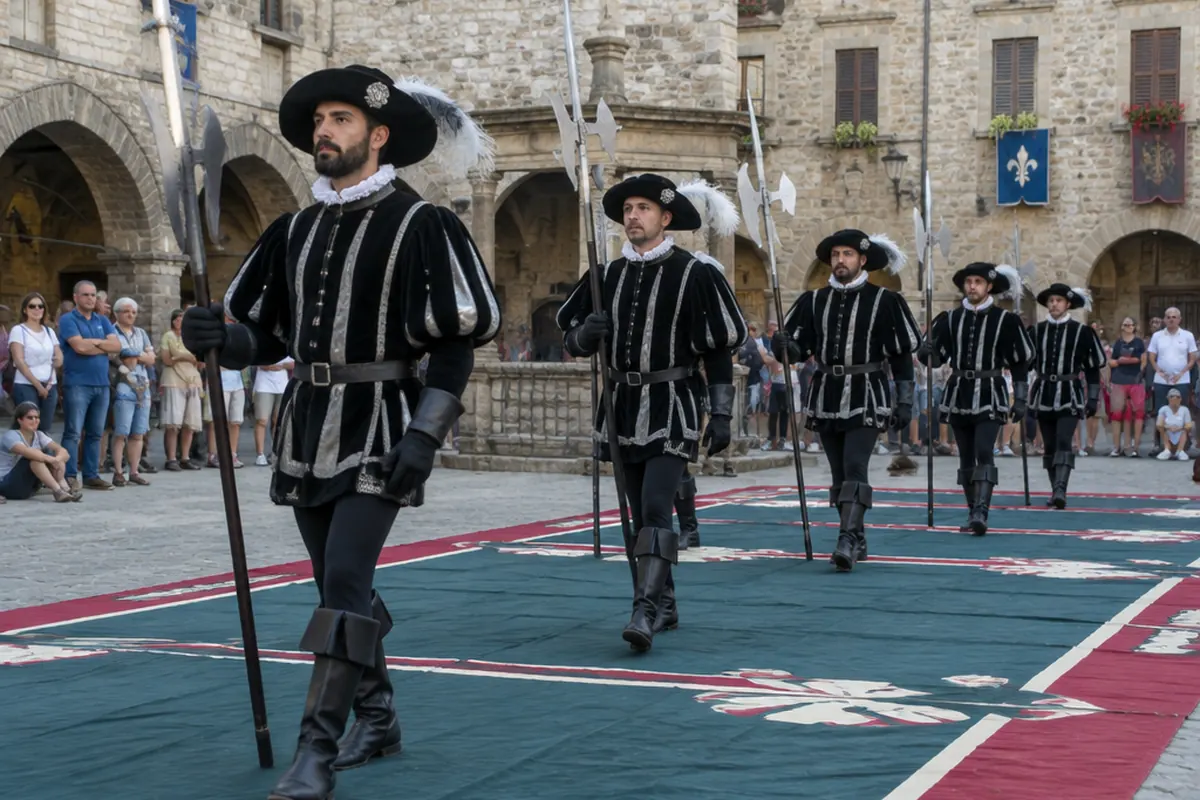
The house of Spades is the soldiers, in black and silver, with a standard-bearer for the ace. When the first spade is played, the card lifts on the cloth and the Herald calls "Spades are drawn!" as a soldier draws his sword. A broken nil makes the bidder's banner shudder, a made nil sets off fireworks, and when a side is set the square dims and its banners sink for a beat.
According to Pagat, Spades was invented in the United States in the 1930s, from the Auction Whist family, and was little known abroad until the mid-1990s. Whist is also the game that the living whist troupes of the 1890s danced out on a cloth laid on the floor, the show this table's Company is modeled on. The suit's English name comes from the Spanish espada, sword, given to the French pike sign (Wikipedia). The French names of the spade court, and why this jack shows one eye, are on the Company page.
Questions players ask
Where are the jokers and the deuces?
Some regions play with a Big Joker and a Little Joker, or with the 2 of diamonds or 2 of spades promoted to high trump. This table plays the standard 52-card game: the ace of spades is the highest card in the deck and the 2 of spades the lowest trump.
Is there a bonus for taking all thirteen tricks?
No. The Herald calls it, but the hand scores like any made contract. A side that bids 11 and takes all 13 scores 11 × 10 plus 2 for the overtricks, 112 in all, and marks 2 bags.
Can I bid zero and just play it as a normal bid?
No. A bid of zero is always nil, with its 100 points riding on it. If you don't want that risk, bid at least 1.
Can my partner and I pass cards or talk over the bid?
No. The only exchange is the one after a blind nil. Dottie bids from her own hand and can see your bid, as you see hers.
Why does a side lose at −200?
It's a mercy rule: it ends a match that has become lopsided. Some groups use −500; this table uses −200 at both targets. The check comes at the end of a hand, never in the middle of one.
Sources
- SpadesPagat (John McLeod)
- How to Play SpadesBicycle Playing Cards
- French-suited playing cardsWikipedia
Last updated