
Cribbage
Play two-handed, six-card Cribbage against Mike, a computer player who knows the discard tables and hates leaving you a count of five. Lay away to the crib, peg your way through the play, and race his peg around the board to 121.
How this table works
Before the first deal you see the rules and three options. The game goes to 121 points, the standard, or 61 for a short game. Count it yourself is off by default, and muggins, which works only when you count for yourself, is off. You also set Mike to Easy, Standard, or Expert for the whole game.
A new game opens with the cut for the deal: tap the deck or the Cut button. To lay away, tap two cards (tap again to lower one) and press Lay away. In the play, one tap plays a card; cards that would take the count past 31 are dimmed. You never have to say go: when you have no legal card, the table says it for you.
In the count, the Herald calls each hand in the old words. With Count it yourself on, your four cards and the starter come back to your hand and number buttons appear on the cloth; tap or type your total, and the true count follows, itemized.
Undo (key U) steps back to your last decision; Hint (key H) shows what Expert would do, including your two cards for the crib. The Menu holds Replay this deal, Today's deal, statistics (with skunks given and received), and Copy deal details. Table settings cover card size, four-color suits, speed, and Tap twice to play, and the Classic button swaps the portraits for plain faces. To let the Company play a game by itself, watch a hand. Need to look busy? The ` key covers the board with a screen of office work.
How to play
Two players, one 52-card deck. For runs and for the cut, aces are low and kings high, so Q-K-A is never a run. For counting, an ace is 1, tens and face cards are 10, and every other card is its number. Points are pegged the moment they're earned, and the first player to reach 121 wins on the spot, even in the middle of the play.
The cut, the deal, and the crib
Each player cuts a card and the lower rank deals first; equal ranks cut again (a jack and a queen are not a tie: the jack deals). After that the deal alternates every hand. The dealer gives 6 cards to each player, the non-dealer first. Each of you then lays away 2 cards face down. Those 4 cards are the crib, and they belong to the dealer. You keep 4.
The starter and his heels
Once both discards are in, the next card of the deck is turned face up as the starter. It is never played, but it counts as a fifth card in both hands and in the crib. If it's a jack, the dealer pegs 2 at once for his heels, before a card is led.
The play
The non-dealer leads. You take turns laying one card face up and calling the running count, which may never pass 31. A player who has no card that fits says go, and the other keeps playing as long as they can. These score for the player who lays the card:
- A count of exactly 15: 2.
- A count of exactly 31: 2.
- A card of the same rank as the one before it: 2 for a pair, 6 for three in a row (a pair royal), 12 for four (a double pair royal). A ten and a queen are not a pair.
- A run: when the last 3 or more cards of the count are consecutive ranks in any order, with no repeat among them, 1 per card, up to a run of 7.
- The last card of a count that stops short of 31: 1, whether the other player said go or simply ran out of cards.
One card can score several of these. Mike leads a 7; your 8 makes fifteen two; his 6 is a run of three at 21; your 9 is a run of four at 30, and if neither of you can play again, the 9 also takes one for last. Making 31 exactly scores its 2 instead of the point for last, never both. When neither player can go on, the count starts again at 0, led by the player who did not lay the last card. Pairs, runs, and fifteens never reach back across that reset.
The count
After all eight cards are played, the hands are counted with the starter, always in the same order: the non-dealer's hand, then the dealer's hand, then the crib. If the non-dealer counts out, the dealer's hand and crib are never counted.
In each hand of five cards (four plus the starter) you score:
- 2 for every different combination of cards that totals 15.
- 2 for every pair, so three of a kind is three pairs and four of a kind is six.
- For runs, the length of the longest run, counted once for each different set of cards that makes it. 9-10-J-Q is one run of four, never a run of four plus two runs of three; a duplicated card doubles the run, so 6-7-7-8 holds two runs of three. The longest run a hand can hold is 5 cards.
- A flush: 4 when the four cards in your hand share a suit, 5 when the starter matches too. The crib scores a flush only when all four crib cards and the starter share a suit, for 5.
- His nobs: 1 for a jack in the hand or crib of the same suit as the starter. A jack turned as the starter is his heels, not his nobs.
The best possible hand is 29: three fives and the jack, with the fourth five of the jack's suit turned.
Winning, and the skunk
The game ends the moment a peg reaches 121; there is no need to land on it exactly. In a game to 121, a loser who finishes below 91 has been skunked, and below 61 double skunked.
Scoring
| Combination | In the play | In a hand or the crib |
|---|---|---|
| Fifteen | 2 | 2 each |
| Thirty-one | 2 | None |
| Pair | 2 | 2 each |
| Pair royal (three of a kind) | 6 | 6 |
| Double pair royal (four of a kind) | 12 | 12 |
| Run | 1 per card | 1 per card, for each run |
| Flush | None | 4 in hand, 5 with the starter; crib 5 only with the starter |
| Last card (go) | 1 | None |
| His nobs | None | 1 |
| His heels (jack starter, dealer) | 2, pegged at the turn | |
A hand counted line by line. You hold 4♥ 5♦ 6♠ J♣ and the starter is the 5♣. The Herald counts it the way you would at the kitchen table:
- 5♦ and J♣ make fifteen two: 2 points.
- 5♣ and J♣: fifteen four.
- 4♥ 5♦ 6♠: fifteen six.
- 4♥ 5♣ 6♠: fifteen eight.
- The two fives are a pair: 2 more, 10.
- 4-5-6 is a run of three, and the second five makes it twice: 3 and 3, 16.
- The J♣ matches the starter's suit, so his nobs adds 1: 17.
The same cards as a crib are worth less when they're suited. 2♥ 4♥ 6♥ 8♥ with the 3♠ turned counts 11 in your hand (two fifteens for 4, the run 2-3-4 for 3, the four-card flush for 4) but only 7 in the crib, because a crib flush needs the starter.
Playing it well
Judge the discard by the whole deal
The discard is where most games are won. Weigh each way of splitting your six cards by what the four you keep average over the 46 starters you can't see, then add what the two you throw are worth to the crib if it's yours, or subtract it if it's Mike's. As dealer with 5♥ 5♦ J♠ Q♣ 2♥ 8♦, keeping 5-5-J-Q averages about 12.7 points and the 2-8 adds about 3.6 to your crib, roughly 16 in all. Throwing the fives to your own crib (worth about 9 there) and keeping J-Q-2-8 (about 2) comes to 11.
Feed your crib, starve his
The discard tables published by the Schellsburg Cribbage Forum, averaged over every possible deal, put a random crib a little under 5 points. Into your own crib the best throws are a pair of fives (about 9), 5-J (7.0), 2-3 (7.0), and 5 with any other ten-card (6.7). Into the opponent's crib, the cheapest are wide, unconnected cards: K-10 (2.9), Q-9 (3.0), K-9 (3.1), Q-6 (3.1). That spread, two to four points a hand, is the biggest skill edge in the game. As non-dealer with 5♠ 5♣ 9♦ K♥ 2♠ 3♣, throw the 9 and the king and keep 5-5-2-3; giving the dealer a five is almost always a gift.
Keep what multiplies
Pairs and touching cards multiply with the starter; a lone fifteen doesn't. As non-dealer holding 4♦ 5♠ 6♥ 9♣ K♣ Q♦, keep the 4-5-6 and one ten-card and throw the other two high cards. Any 4, 5, or 6 turned gives you a double run, and every ten-card makes another fifteen. Don't break a pair or a run to keep a single fifteen unless the crib swing pays for it. Flushes are a tiebreaker only: a crib flush turns up about once in 675 deals.
The lead and the count
Sixteen of the 52 cards count ten, so leading a 5 hands the dealer a fifteen. A 4 is the classic safe lead, since no single card makes 15 on it, and a card from a pair invites a pair you can answer with a pair royal. In the middle of a count, don't leave it at 5 or 21: any ten-card makes 15 or 31 on you. Leaving 10 or 11 is a softer risk, since a five or a four answers it.
When you can choose between a fifteen and a pair, take the fifteen: the pair gives your opponent a shot at a pair royal for 6.
Hold back for the go
Points for last and for 31 usually come from low cards kept to the end. With 3♣ and 9♥ left and the count at 19, play the 9 to 28 and keep the 3 to finish with 2 for thirty-one if the go comes back to you.
Play the board
Near the end, remember the order of the count. The non-dealer counts first, so a non-dealer within a hand's reach of 121 can keep the four cards that count surest rather than the ones that peg. A dealer who needs pegging points to get home should keep low cards and pairs instead of the biggest counting hand. Far behind and facing the skunk line, keep the hand with the highest ceiling, not the safest average.
The Company in Cribbage

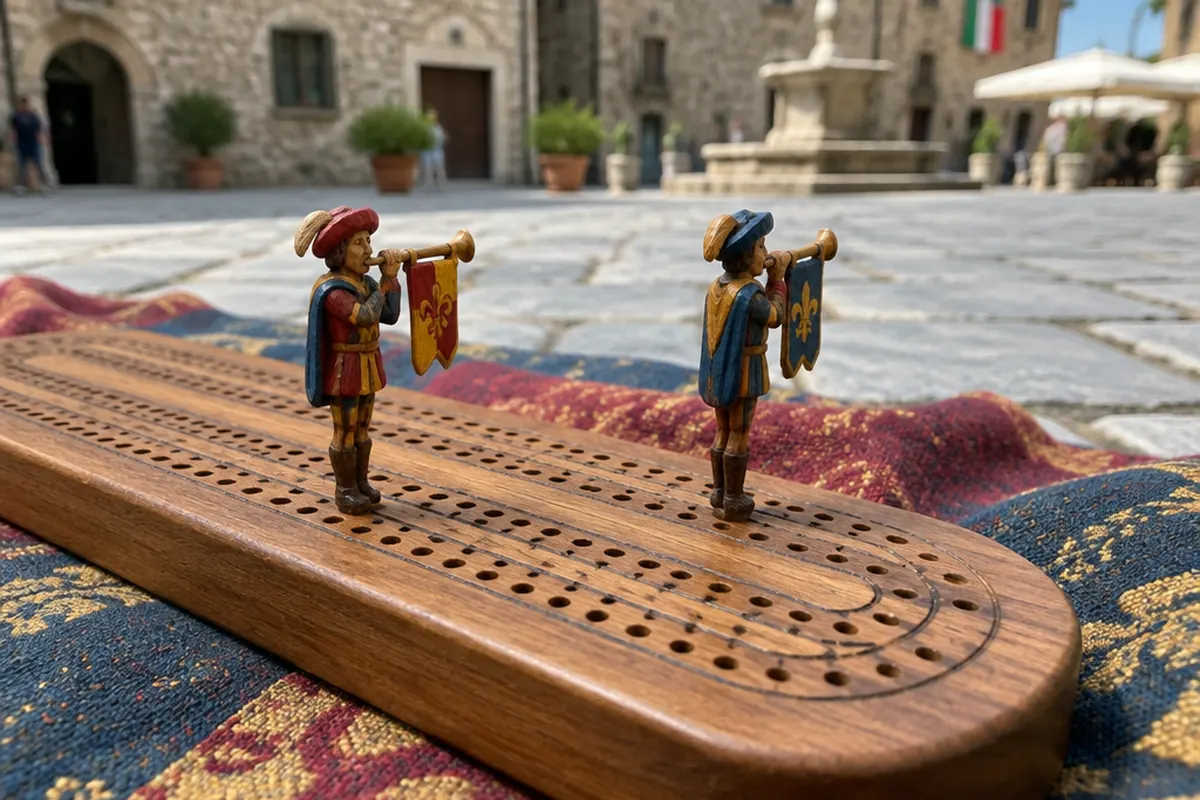
The board runs across the top of the cloth, and two small heralds march the pegs along it, each leaving a back pin in the hole it came from. When the starter is a jack, the card lifts and glows while the Herald calls "Two for his heels!" In the count, each phrase lights the cards it names, and a jack of the starter's suit steps up for his nobs. In a game to 121 the skunk lines are drawn on the board, and they flash if the loser's peg is still behind one at the end.
According to Wikipedia, the antiquarian John Aubrey credited the game to the English poet Sir John Suckling, who built it in the early 1600s out of an older game called noddy. Why the Jack of Hearts shows only one eye, and his traditional French name, are on the Company page.
Questions players ask
Why are some totals missing from the buttons when I count my own hand?
A few totals can't be made by any five cards, one in the teens and three in the middle twenties, so the table leaves them off. The one in the teens is why players call a hand with nothing in it "nineteen": it's a count no hand can show.
Does Mike know what's in the crib, or what the starter will be?
He knows the two cards he laid away himself, as you know yours, and nothing more. He sees only his own cards and those already played, never your hand, your two crib cards, or the deck. The shuffle for each deal is set by its deal number, so you can replay any deal and get the same cards.
Is there a cut before the starter is turned?
Not as a separate step. The starter is simply the next card in the shuffled deck after the 12 dealt, which is the same as a fair cut of the cards that are left. The cut you make yourself is the one at the start of each game, to see who deals first.
What happens when I count too high or too low with Count it yourself?
Claim more than your hand is worth and you're pegged the true count, with no penalty. Claim less and you keep only what you claimed. With Muggins on, Mike then takes the points you missed; with it off, they're simply lost. Muggins never applies to pegging points in the play or to his heels.
Does a skunk count double here?
No. A win is a win, but the statistics keep separate counters for skunks and double skunks, given and received. Games to 61 never record a skunk.
Sources
- Six Card CribbagePagat (John McLeod)
- How to Play CribbageBicycle Playing Cards
- Rulebook 2025American Cribbage Congress
- Discarding to the crib (archived copy)Schellsburg Cribbage Forum
- CribbageWikipedia
Last updated