
Golf (Six-Card)
Play six-card Golf against one, two, or three computer players, with the standard American card values and the column-pair rule. Pair up your columns, keep the leftovers low, and play nine holes or eighteen.
How this table works
Before the first deal you choose how many computer players join you (3 computer players by default) and how many holes to play (9 holes, or 18 for a long game). Dale, Priya, and Marcus take the seats in that order, and each plays at the level you pick, Easy, Standard, or Expert, for the whole match.
Your six cards sit large at the bottom of the cloth, with the stock, the discard pile, and the card you just drew beside them. At the start of a hole, tap two of your cards to turn them up. On your turn, tap the stock or the discard pile, then tap the card in your layout you want to replace. To throw away a card drawn from the stock, tap the discard pile or press Discard it. On a keyboard, S draws from the stock, D takes or makes a discard, and the arrow keys move around your layout.
Every banner shows that player's running total and what their face-up cards are worth right now, pairs counted as zero, so you can see who is close to going out.
Undo (U) steps back to your last decision of the hole, and Hint (H) shows the move an Expert player would make. The Menu has Replay this deal, Today's deal, statistics, and Copy deal details. Table settings change card size, four-color suits, and speed; the Classic button trades the Company for plain faces. To see the Company play nine holes on its own, watch a hand. Each hole opens with a short trumpet call and the cards make soft sounds; the speaker button switches sound off or back on.
The Intermission button
Someone coming on the back nine? Tap Intermission on the toolbar, or press ` (left of 1: the panic key unless you change it), and the course disappears behind office work or a plain curtain. If the browser allows, the cover takes the whole screen and the tab gets a dull title. Escape twice is quieter: it covers the window only. Return with the panic key, Escape twice, or the small corner control, and the hole picks up where it stopped. Table settings, under Menu, set the Intermission screen (Curtain, Spreadsheet, Dashboard, Report, Code editor, Inbox, or Project plan), Go full screen, and the Panic key: `, \ or F2. More here.
How to play
This is the six-card game, the one most people mean when they say Golf at the card table, and not the solitaire of the same name. It uses one 52-card deck with no jokers, for 2 to 4 players. The aim is the lowest score.
The deal
Each player gets 6 cards face down, laid out in two rows of three. The rest of the deck is the stock, and its top card is turned face up to start the discard pile. You play first on the first hole; after that the lead moves one seat clockwise every hole.
Turning up two
Going around the table, each player turns 2 of their own cards face up, any two they like. The other 4 stay face down. You may not peek at them: you find out what a face-down card is only when you replace it, or when the hole ends and everything is turned up.
Your turn
Take the top card of the stock or the top card of the discard pile. Then:
- A card from the stock may replace any one of your six cards, face up or face down, or you may simply discard it.
- A card from the discard pile must replace one of your six. Picking it up and throwing it straight back is not allowed.
The new card goes face up in the old card's place, and the card it replaced goes face up on the discard pile, where the next player may take it. If a replaced face-down card was a king, it's on the pile now, for the next player.
Pairs in a column
Your layout has three columns of two cards. Two cards of the same rank in one column score 0 for that column, whatever their suits. That holds for twos as well: a pair of twos scores 0, not double the minus. Only columns count. Two sevens side by side in a row, or on a diagonal, score seven each. With three sevens in the layout, only the column holding two of them is zero.
Going out and the last turn
A player goes out by replacing their last face-down card, so that all six are face up. Discarding a stock card turns nothing over, so with one card still face down you can keep drawing and discarding for as long as you like, waiting for something good.
Once someone goes out, every other player gets exactly 1 more turn, in order around the table. The player who went out doesn't play again. If someone else turns up their last card during those turns, nothing changes; the hole still ends when the last of them has played. Then all remaining face-down cards are turned up and every layout is scored. Pairs that appear only at that moment count, and so does a queen you never knew you had.
Going out earns nothing by itself and costs nothing either.
If the stock runs out
If it happens, the discard pile, all but its top card, is shuffled into a new stock. If there aren't enough discards for that, the hole ends and is scored as it lies.
The match
A match is 9 holes, or 18 with the long option. Hole scores add up, and the lowest total at the end wins. Totals can go below zero. If two players tie for the lowest total, they share the win; there is no playoff hole.
Scoring
| Card | Points |
|---|---|
| Ace | 1 |
| 2 | −2 |
| 3 through 10 | Face value |
| Jack | 10 |
| Queen | 10 |
| King | 0 |
| Two of the same rank in one column | 0 for the column |
A hole score is the sum of your three columns. The best possible hole is −6 (three kings each over a 2) and the worst is 60 (three columns of a jack and a queen, which are not a pair). There are no bonuses: four of a kind in two columns is simply two zero columns.
A worked hole. Dale goes out by turning up his last card. Priya and Marcus take their last turns, and the last one falls to you. You show 9♣ K♠ 4♦ over 9♥, a face-down card, and 7♠. Marcus has just thrown the J♣, which is no use to you, so you draw from the stock and get the 2♣. You put it under your K♠, replacing the face-down card, which turns out to be the Q♠. Then every card is turned up.
- You, 9♣ K♠ 4♦ over 9♥ 2♣ 7♠. Left column, the nines: a pair, 0. Middle: K♠ 0 plus 2♣ −2 = −2. Right: 4 + 7 = 11. Your hole: 0 + (−2) + 11 = 9.
- Dale, 6♦ 6♠ A♥ over 6♣ 4♥ A♠. Left column, the sixes: 0. Middle: 6 + 4 = 10. Right, the aces: 0. His hole: 10. He has three sixes, but only the pair in one column counts.
- Priya, Q♥ 5♦ 8♠ over J♦ 5♣ 3♠, with the J♦ face down until the end. Left: 10 + 10 = 20, since a jack and a queen are different ranks. Middle, the fives: 0. Right: 8 + 3 = 11. Her hole: 31.
- Marcus, K♦ 10♠ 2♦ over 2♥ 10♦ K♣. Left and right are each a king with a 2: −2 and −2. Middle, the tens: 0. His hole: −4, the best at the table.
Dale went out, and Marcus won the hole. Had you discarded the 2♣, the Q♠ would have come up at the end under your king, the middle column would have been 10, and your hole would have been 21 instead of 9.
Playing it well
Know what a pair is worth
A pair saves the value of both cards. Pairing nines takes 18 points off your score; pairing jacks, queens, or tens takes off 20. Pairing aces saves only 2, and pairing kings saves nothing at all. Pairing twos actually costs you 4, because two separate twos are worth −2 apiece. So chase pairs from fives up to queens, and don't bother with the rest.
King over two is the best column you can build
A king with a 2 scores −2, which beats any pair. If you hold a 2 over a 2 and a king comes along, put the king on one of the twos: the column goes from 0 to −2. Once you have a king over a 2, leave that column alone for the rest of the hole.
What a face-down card is worth
Over a full deck, an unknown card averages about 5.46 points. That is the bar a new card has to clear. A king, 2, ace, 3, or 4 on the discard pile is worth taking just to replace a face-down card, because on average it saves you something. A 7 is not, unless it pairs a card you already show or replaces a jack or queen you can see. As the hole goes on, look at what has turned up: if most of the kings and twos are already showing in other layouts, your hidden cards are probably worse than average.
Clear the picture cards first
A face-up jack or queen is a sure 10. With Q♥ 5♠ and a face-down card in the top row, 5♦ below the 5♠, and a 3 drawn from the stock, put the 3 on the queen: you save 7 for certain, which beats gambling on a face-down card that might already be low.
Pair against a card you can see
The chance that one particular face-down card matches a given rank is only about one in seventeen while that rank is still unseen. So build pairs on purpose: if you show a 9 with a face-down card under it and a 9 turns up on the discard pile, take it and put it under your 9. You make a sure 0 out of what was 9 plus an unknown card.
Turn up two different columns
At the start, turn up one card in each of two columns. You learn about two columns instead of one, and you have two cards to pair against instead of one.
Don't feed the table
Before you discard, look at the layout of the player who goes next. If Dale, who plays right after you, shows an unpaired queen with a face-down card under it, your queen on the discard pile hands him a zero column where he had 10 plus whatever lies under it. If keeping the card costs you only a few points, keep it. The same goes for the card you replace: it lands on the pile too.
Go out only when you're ahead
Everyone else gets one more turn after you go out, and you don't. Before you turn up your last card, add up what you show and compare it with what the others show, allowing about 5.46 for each of their face-down cards. If you're not clearly lower, discard instead and wait for a king, a 2, or another low card to finish with. Going out at 15 when Marcus shows 6 with one card down gives him a free swing at the hole.
The Company in Golf
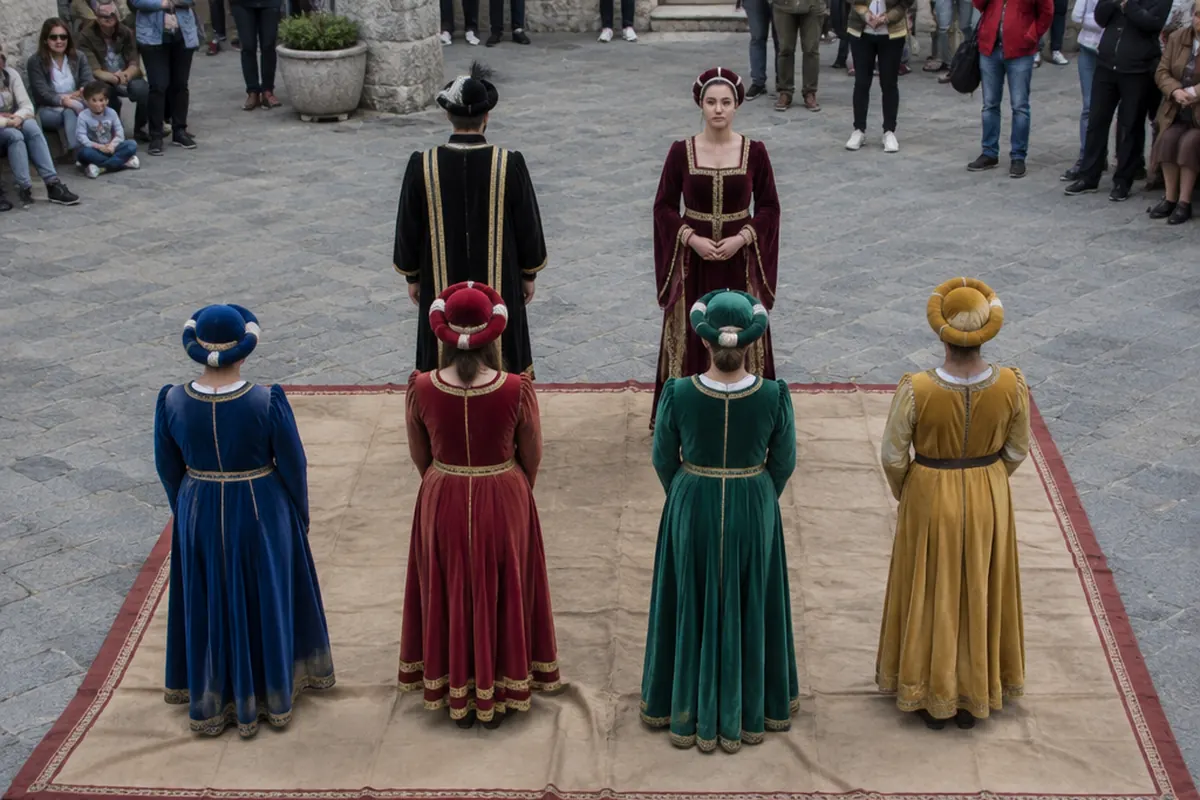
Each layout is six performers standing in two rows of three, most of them with their backs turned until their card comes up. When two of the same rank meet in a column, the pair steps forward, bows, and settles back, marked zero, and the Herald names it. When someone turns up a last card, the Herald calls "Last turn!" and that player's banner flourishes. At the end of a hole every performer turns to face the square at once.
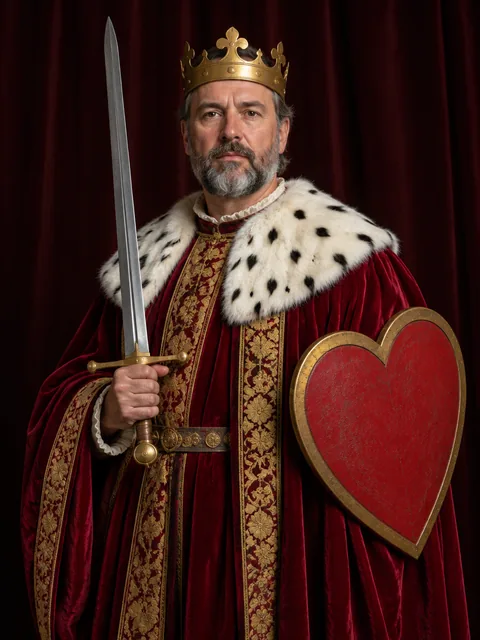
The kings are the cards you want most in this game. On the King of Hearts the sword appears to go into his own head; Wikipedia gives the widely repeated explanation that an ax head was lost through centuries of copying. The other three kings, with their French names, are on the Company page.
Questions players ask
We always ended the hole the moment someone turned up their last card. Can I play it that way?
Not at this table. Here everyone else gets one more turn, which Pagat notes many groups play, and which keeps the player who goes out from winning on timing alone. Bicycle's printed rules end the hole at once.
What changes between Easy, Standard, and Expert?
An Easy player takes the discard only when it is very low, never plans a pair, and goes out without looking at the score. A Standard player works out what every possible swap does to each column and won't break a pair for nothing. An Expert also keeps track of every card that has shown, lines up pairs against cards it can see, and holds back a card that would complete a pair for the next player.
Do the computer players know what their own face-down cards are?
No, and neither do you. A computer player sees exactly what you would see from its chair: the face-up cards, the discard pile, and the card it just drew.
Why didn't the computer go out when it could have?
Standard and Expert players won't turn up their last card when they think they are behind, since everyone else would get a last turn against a weak layout. With one card still face down they discard and wait.
Sources
- GolfPagat (John McLeod)
- Six Card GolfBicycle Playing Cards
- Golf (card game)Wikipedia
- King (playing card)Wikipedia
Last updated