
Rummy
Play basic Rummy against one, two, or three computer players. Draw from the stock or pick up the last discard, put down sets and runs, tack your spare cards onto anybody's melds, and be the first with an empty hand. Everyone else then pays you for the cards still stuck in their hands.
How this table works
Before the first deal you set the number of computer players (1 computer player by default), the match target (100 points), how aces work (low by default), how many melds a turn you may put down (any number), and what happens when the stock runs out (turn it over as it lies). Mabel takes the first seat, then Gus and Irene when you ask for more company, all at the level you choose: Easy, Standard, or Expert. Nobody changes level halfway through a match.
The stock and the discard pile sit at the top of the cloth. Below them, in smaller cards, lie the melds every player has put down. Each banner shows how many cards that player holds and, when it took a card from the pile, which card that was, since everyone at a real table would have seen it go.
Your turn has two halves. First draw: tap the stock or press Draw from the stock (D), or tap the pile or press Take (T). Then tap the cards you want to use. Pick three or more that make a meld and the Meld button lights up (M). Pick a single card and every meld it fits glows gold; tap one to lay the card off there. To end your turn, pick one card and tap the pile, or press Discard (D). Clear (C) drops your picks. The card you have just drawn has a green edge so you can find it.
Undo (U) takes back your last decision and Hint (H) shows what an Expert would do next. The Menu has Replay this deal, Today's deal, statistics, and Copy deal details, and Table settings change the card size, the four-color suits, the speed, and the deck, Company or Classic. To see the Company play on its own, watch a hand. Sound is off until you press the speaker button; then a fanfare greets every player who goes out.
The Intermission button
Someone heading your way? Hit Intermission in the toolbar, or the panic key (` unless you picked another). A work screen or a curtain covers the melds and your hand; where the browser lets it, it takes the whole screen and the tab title goes plain. Pressing Escape twice drops back to a window. Your cards return exactly as they were with the panic key again, Escape twice, or the little control in the corner. Menu, Table settings picks the screen (Spreadsheet, Report, Inbox, Dashboard, Project plan, Code editor, or Curtain), turns Go full screen on or off, and sets the Panic key to `, \ or F2. More about it.
How to play
Settling a question at the table? See the full Rummy rules.
This is the plain, original Rummy that Bicycle files under "Rummy (Rum)" and Pagat calls Basic Rummy, sometimes known as Straight Rummy. It uses one 52-card deck with no jokers and seats 2 to 4 players here. It is not Gin Rummy, which is a separate two-player game with knocking, and not Rummy 500, where melds score points; both are described at the end of this page.
The deal
With two players each gets 10 cards; with three or four, 7 each. The next card is turned face up to start the discard pile, and the rest of the deck sits face down beside it as the stock. The player to the dealer's left goes first. In a game of two the winner of a hand deals the next one; with more players the deal simply moves one seat to the left.
Your turn
- Draw. Take the top card of the stock, which nobody has seen, or the top card of the discard pile, which everybody has.
- Meld, if you want to. Lay down a set, three or four cards of one rank such as 9♣ 9♦ 9♥, or a run, three or more cards in a row in one suit such as 4♠ 5♠ 6♠ 7♠.
- Lay off, if you want to. Add cards from your hand to any meld on the table, your own or someone else's, as long as it stays a set or a run.
- Discard. Put one card face up on the pile. That ends your turn. If you began by taking the top discard, you may not throw that same card back this turn.
Aces are low by default, so A-2-3 is a run and Q-K-A is not. With the ace option set to high or low, Q-K-A counts too, but a run can never wrap around the corner as K-A-2 would.
No rearranging. A card on the table stays in the meld where it was put. If a set of four 2s and the run 3♠ 4♠ 5♠ are down, the A♠ fits nowhere: the 2♠ would have to leave its set first, and that's not allowed.
Going out
The moment your hand is empty, the hand ends. You can get there by discarding your last card, by laying it off, or by melding everything you hold without a discard at all. Nobody gets another turn to put down what they were saving.
When the stock runs out
If the stock is gone and nobody has gone out, the next player either takes the top discard or turns the whole pile over, without shuffling, as a new stock and draws from it. The shuffle option mixes the pile first instead, which Pagat says most books now do. To stop a hand from going round forever, this table follows Pagat's suggestion: once the stock has run out for the 3rd time, a player who doesn't want the top discard ends the hand.
Scoring
When someone goes out, every other player pays the winner the value of the cards left in hand, melds that were never put down included:
| Card | Points |
|---|---|
| King, queen, jack, 10 | 10 |
| Ace | 1 (15 when aces may be high) |
| 2 to 9 | The number on the card |
Going rummy means getting rid of your whole hand in a single turn when you had not put down or laid off a single card earlier in that hand. Then everyone pays you double. It's a gamble, because the cards you're holding back count against you if somebody else goes out first.
A hand that ends with nobody out is scored the way Pagat describes: everyone counts their cards, the lowest count wins, and that player collects the difference from each of the others. If the lowest count is shared, the winnings are split evenly, each share rounded down; that rounding is this table's own ruling. Points carry over from hand to hand. When a hand ends with someone at or past the match target, the highest total wins; if the highest total is shared, one more hand is played. Neither rulebook fixes a target, so 100 is this table's choice, a match of several hands with one computer player.
A worked hand. Three players. You go out by discarding your last card, and the others still hold:
- Mabel: K♦ 7♣ A♥. That's 10 + 7 + 1 = 18.
- Gus: 10♠ 10♣ 2♦. That's 10 + 10 + 2 = 22, even though the two tens were halfway to a set.
You collect 18 + 22 = 40 points. Had you put your whole hand down in that one turn, with nothing laid down before, it would have been rummy and you would have collected 80.
Playing it well
Put melds down early at a full table
With three or four players somebody usually goes out quickly, and every meld still in your hand is paid for at full value. Lay down what you have. The only real reason to wait is a shot at rummy, and that makes sense mainly in a two-player game when you're one card away and the other hand is still long.
Throw the expensive strays first
A king that belongs to nothing costs 10 if the hand ends now; a stray 3 costs 3. Unless the king is part of a pair you're hoping to fill, it should be the first card to go.
Read the pile and the banners
Every card a player takes from the pile is shown on that player's banner. If Mabel picked up the 8♥, don't hand her the 7♥ or the 9♥, and think twice about another 8. Cards already sitting in the pile or in melds are dead to you: a pair of jacks is worth much less when the other two jacks are gone.
Use other people's melds
You can lay off on any meld on the table. A lonely J♥ is worth keeping when someone has 8♥ 9♥ 10♥ down, because it goes out of your hand for free on your next turn. Check the table before you decide a card is useless.
Keep a card you can throw
Picking up the top discard means you can't throw it straight back. Before you take it, make sure you will still have another card to discard after your melds; with nothing else in hand you couldn't finish the turn.
The Company in Rummy

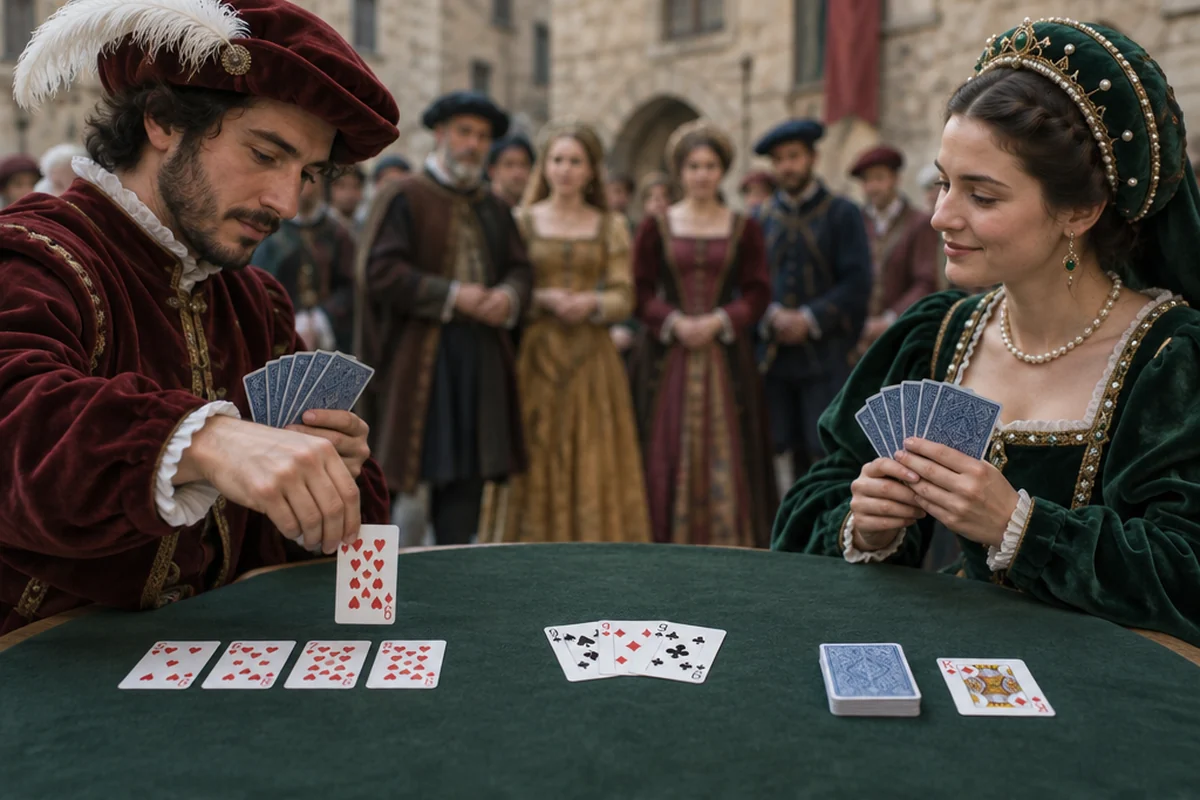
The cards on the cloth are the people of the square, and in Rummy they gather into little groups as the hand goes on: three of the same rank standing shoulder to shoulder, or a family of one suit lined up in order of age. When you put a meld down it walks onto the cloth to join the others, and when somebody lays off a card it slips in at the end of its line. The Herald calls out whoever goes out, adds a trumpet for rummy, and ends a hand nobody won with a quiet word.
Rummy itself is young as card games go. Pagat dates it to the early twentieth century and thinks it probably comes from the Mexican game Conquian. Bicycle calls it one of the best-known card games in the United States, even if Gin Rummy has taken over in many places.
Questions players ask
Is this Gin Rummy?
No. In Gin Rummy two players hold their melds until someone knocks, and the score is the difference in loose cards. Here melds go down on the table during play, anyone can lay off on them, and the winner collects every card left in the other hands. The site has a separate Gin Rummy table.
What about Rummy 500?
Rummy 500 is a different game in which melds score points for the player who put them down, and more than one card can be taken from the discard pile. Many people call it simply Rummy. It isn't played here; this table plays the basic game.
Can I meld more than once in a turn?
Yes, by default: Bicycle lets you put everything down on the turn you go out, and Pagat lists "as many melds as you desire" as a house rule some people play. Pagat's basic game allows only one meld a turn, and the options list has that too. Laying off is never limited.
Why can't I discard the card I just picked up?
Both rulebooks forbid it: taking the top discard and throwing it straight back would leave the pile unchanged. You can discard that card on a later turn, and a card drawn from the stock can be discarded at once.
What's the difference between Easy, Standard, and Expert?
An Easy player melds whatever it can at once, takes the discard only when it sees an instant meld, and throws its spare cards without much thought. A Standard player sorts its hand into the melds that leave the fewest points loose, goes out the moment it can, sheds its costly strays, and avoids feeding the next player. An Expert also keeps count of the dead cards and of what the next player might hold.
Do the computer players see my cards?
No. Each sees what you see from your chair: its own hand, the melds, the pile, how many cards everyone holds, and the cards people took from the pile, as the fair play page explains for every game here.
Sources
- Rummy (Rum)Bicycle Playing Cards
- RummyPagat (John McLeod)
Last updated