
Crazy Eights
Play Crazy Eights against one, two, or three computer players: lay a card that matches the top of the pile by suit or by rank, throw an eight on anything to call a new suit, and race to empty your hand. Whoever goes out collects points for the cards everyone else is stuck with.
How this table works
Before the first deal you choose the number of computer players (3 computer players by default), the match target (250 points), how many cards each two players get (7 cards by default), what happens when the stock runs out (reshuffle the pile by default), and whether the special cards are in play (off by default). Della, Hank, and Opal take the seats in that order, all at the level you pick: Easy, Standard, or Expert. Their level stays put for the whole match.
The stock and the pile sit in the middle of the cloth, with a badge beside them that shows the suit to follow; after an eight it glows gold with the suit that was called. Each banner shows how many cards that player holds. Tap a card that fits and it goes straight onto the pile. Tap an eight and four buttons appear, Hearts, Diamonds, Clubs, and Spades, so you can call the suit; the keys 1 to 4 do the same. To draw, tap the stock or press Draw a card, or press D. When nothing fits and nothing is left to draw, the button reads Pass (P on a keyboard).
Undo (U) takes back your last decision, and Hint (H) shows what an Expert would do. The Menu holds Replay this deal, Today's deal, statistics, and Copy deal details. Table settings change the card size, the four-color suits, the speed, and the deck, Company or Classic. To see the Company play a match on its own, watch a hand. Sound stays off until you tap the speaker button; after that the Herald's trumpet greets every eight that calls a new suit.
The Intermission button
If a colleague drifts over, press Intermission in the toolbar or the panic key (`, left of 1, unless you changed it). A work screen or a plain curtain slides over the stock and the pile; where the browser allows, it fills the screen and the tab title goes dull. Escape pressed twice hides only the window. The panic key again, Escape twice, or the small corner control brings your hand back untouched. In Menu, Table settings you choose the screen (Spreadsheet, Report, Inbox, Dashboard, Project plan, Code editor, or Curtain), switch Go full screen on or off, and set the Panic key to `, \ or F2. How it all works.
How to play
Settling a question at the table? See the full Crazy Eights rules.
This is the family game for 2 to 4 players here, with one 52-card deck and no jokers. The goal of each hand is simple: get rid of every card you hold before anyone else does.
The deal and the starter
The dealer hands out cards one at a time: 5 to each player with three or four at the table, and 7 cards each in a game of two (Pagat's count; Bicycle deals five whatever the number of players, and the options list has both). The rest of the deck is the stock, face down. Its top card is turned face up to start the pile; that card is the starter. If the starter is an eight, it goes back into the middle of the stock and the next card is turned instead. The player to the dealer's left goes first, play moves clockwise, and the deal passes one seat to the left after every hand.
Your turn
Play one card face up on the pile. It must match the top card in suit or in rank: on the queen of clubs you can play any club, or any queen. That's the whole matching rule, with one exception that gives the game its name.
Eights are wild. An eight can go on any card at any time on your turn. When you play it, you call a suit, and the next player must play a card of that suit or another eight. You call a suit, never a rank, and the eight's own suit counts only if it's the one you called.
Drawing
Instead of playing, you may draw from the stock, one card at a time, and you keep your turn while you do. You can play any card that fits as soon as you have one, the card you just drew included. Drawing is allowed even when you could have played, so you can hold on to a card you would rather keep. Once you play a card, your turn is over.
When the stock runs out
With the default option, the cards under the top of the pile are shuffled to make a new stock the moment someone needs to draw, and the top card stays where it is, along with any suit an eight called. With the other option, No more drawing, the stock is simply gone: a player who can play must play, and a player who can't passes. In either case, if there is nothing at all left to draw and every player in turn passes, the hand is blocked. It ends with no winner, and nobody collects that hand. That is a ruling of this table: Pagat charges everyone penalty points for a blocked hand, but under Bicycle's way of scoring, where the player who goes out collects, there is nobody to collect.
Going out
The moment you play your last card the hand is over, even if that card is an eight: there is no suit to call because nobody plays after you.
The special cards
Turn on Special cards and three ranks gain the effects Pagat lists as typical. A queen skips the next player; with two at the table you simply play again. An ace reverses the direction of play; with two players it does nothing. A two makes the next player either play another two or draw 2 cards for every two in the run, and that player can't answer with an eight. After drawing them the turn passes on, and the next player follows the last two by suit, by rank, or with an eight. A special card turned as the starter works as if the dealer had played it, and a special card played as someone's last card has no effect: the hand is simply over.
Scoring
The player who goes out collects points from every other player for the cards left in their hands:
| Card | Points |
|---|---|
| Each eight | 50 |
| King, queen, jack, 10 | 10 |
| Ace | 1 |
| 2 to 7, and 9 | The number on the card |
Points carry over from hand to hand. When a hand ends with someone at or past the match target, the match is over and the highest total wins. If the highest total is shared at that moment, one more hand is played. Neither Bicycle nor Pagat sets a target, so 250 is this table's choice, long enough for several hands at a full table; the options list has a shorter and a longer match.
A worked hand. Four players. You play your last card, and the others still hold:
- Della: 8♥ K♠. That's 50 + 10 = 60.
- Hank: A♦ 3♣. That's 1 + 3 = 4.
- Opal: 10♦ 9♠ 2♥. That's 10 + 9 + 2 = 21.
You collect 60 + 4 + 21 = 85 points. If you had 90 going in, you now have 175, still short of the target of 250, so another hand is dealt. Della's eight alone was worth more than Hank's and Opal's hands put together.
Playing it well
Hold your eights
An eight fits everywhere, which is exactly why you shouldn't spend it while anything else fits. Holding 8♠, 6♣, and J♦ with the 9♣ on top, play the 6♣ and keep the eight for the turn when you're stuck. It also costs 50 if someone goes out while it's still in your hand, so don't sit on two or three of them forever either.
Call the suit you're long in
When you do play an eight, call the suit you hold most of. With 8♦, 4♠, 7♠, Q♠, and 3♥, call spades: you have three cards that follow, and whoever answers with a spade hands you a turn where you can play again. The suit of the eight itself doesn't matter.
Shed the expensive cards first
Two cards fit and you can only play one. Play the king, not the three: if the hand ends before you go out, the king costs 10 and the three costs 3. Face cards and tens are the cards you least want to be caught with, eights aside.
Watch the banner counts
When Hank is down to one or two cards, stop handing him the suit he wants. If he drew the last time hearts were asked for, he probably has none, so an eight calling hearts may force him to draw again. Switching to a rank match that changes the suit does the same job without spending your eight.
Keep a way back into your long suit
A card of the same rank changes the suit. With the 7♥ on top and both 7♣ and 2♥ in hand, the 7♣ moves the play into clubs, where you hold four more, while the 2♥ keeps it in hearts, where you hold nothing else. Think about the suit you leave on top, not just the card you get rid of.
Draw on purpose
Drawing when you could play feels wrong, but it has its uses. If your only playable card is your last eight and the stock is thick, one draw may find a card that fits, and you keep the eight for later. Near the end of a stock, though, every card drawn is a card you might be caught holding.
The Company in Crazy Eights

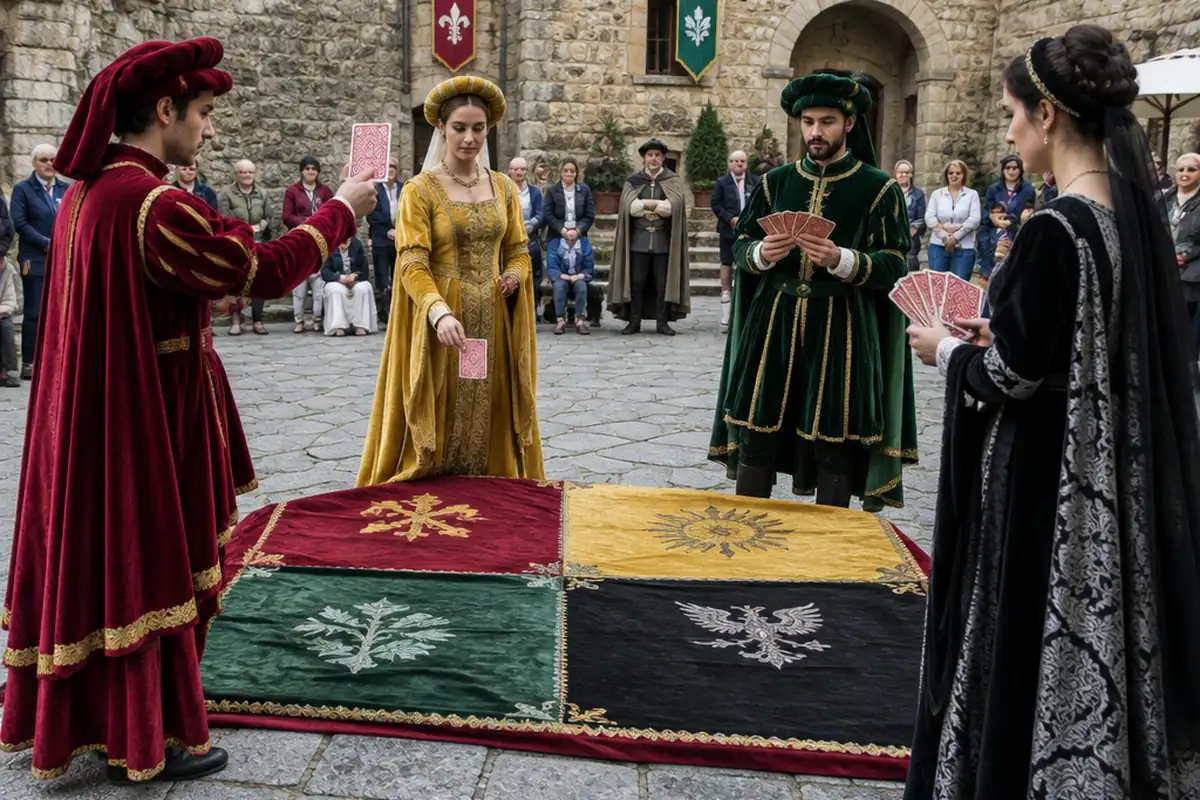
The cards on the cloth are people standing in the square. Each eight is someone the crowd knows: the musician of hearts, the cloth merchant of diamonds, the baker of clubs, and the knight of spades. When one of them is played, the badge by the pile turns to the suit that was called, the Herald announces it with a trumpet, and everyone in that suit is suddenly in demand. A player down to one card gets a warning from the Herald, and going out brings a flourish on that player's banner; fireworks follow when the one going out is you.
The game itself goes by many names. Pagat lists Crates, Switch, Swedish Rummy, Last One, and Rockaway among them, and notes that Germans play it as Mau-Mau, the Swiss as Tschausepp, and the Dutch as Pesten, each with its own house rules about which cards are special.
Questions players ask
Can I play an eight on another eight?
Yes. An eight goes on any card, another eight included, and you call a new suit with it. The next player then follows your suit, not the one called before.
Do I have to say "last card"?
Not at this table. Pagat mentions groups that make a player announce a last card and draw two as a penalty when they forget. Here the banner count and the Herald's warning do that job for everyone.
Why does the hand end with nobody scoring?
Because every player in turn passed with nothing left to draw. With the stock reshuffled from the pile that is rare, since it takes every other card of the deck to be sitting in hands. With No more drawing it happens more often. Bicycle stops at saying that a player who can't play passes, so the scoring of a blocked hand is a ruling of this table.
Can I play more than one card at a time?
No. One card per turn, as in both rulebooks. Pagat describes a house rule where cards of the same rank go down together; it isn't offered here.
What's the difference between Easy, Standard, and Expert?
An Easy player plays whatever fits, eights included, without much thought, and now and then draws although it could play. A Standard player keeps its eights back, sheds the costly cards first, calls the suit it holds most, and turns the suit away when the next player is nearly out. An Expert does all that and also counts what has been played, weighing how likely the next player is to answer each card.
Do the computer players see my cards or the stock?
No. Each one sees what you see from your chair: its own hand, the pile, how many cards everyone holds, and how many are left in the stock, as the fair play page sets out for every game here.
Sources
- Crazy EightsBicycle Playing Cards
- Crazy EightsPagat (John McLeod)
Last updated